FEATURED ARTICLE
10 Career Mistakes to Avoid in Your 20s That Could Cost You Years of Growth
August 24, 2026 9 min read By Litos Research Team
In This Article
Key Takeaways for Young Professionals
- Build Skills, Not Just Titles: Focus on capabilities that increase your long-term value.
- Build Relationships Early: Network before you need a job.
- Use AI Wisely: Let AI expand your thinking, not replace it.
- Make Your Work Visible: Build evidence of what you can do.
- Keep Learning: Avoid becoming comfortable when your growth has stopped.
- Develop Human Skills: Communication, leadership and adaptability matter.
- Own Your Career: Do not wait for someone else to plan your next move.
- Create Career Options: Focus on building skills, evidence, relationships, reputation and adaptability.
Build Your Career Capital
Your career grows through what you accumulate—not just the titles you earn. Build valuable skills, evidence, relationships, reputation and adaptability that create better opportunities over time.
Short Summary
Your 20s are not about having your entire career figured out. They are about building the skills, relationships, reputation and adaptability that give you better choices later.
Some of the most expensive career mistakes at this stage have little to do with choosing the “wrong” first job. They come from staying comfortable for too long, focusing only on salary or titles, neglecting relationships, failing to build visible proof of your abilities and assuming your degree will remain enough.
This guide explores ten career mistakes that can quietly slow your professional growth and, more importantly, what you can do differently.
Why Your 20s Matter More Than Getting the "Perfect" First Job
There is enormous pressure on young professionals to make the right career decision immediately.
Choose the right degree. Find the right job. Join the right company. Get promoted. Earn more.
Real careers rarely develop so neatly.
Your first decade of working life is better viewed as a period of career capital building. Every project, relationship, skill, failure, responsibility and achievement contributes to what you can offer your next employer, client or business partner.
That matters even more in a rapidly changing employment market.
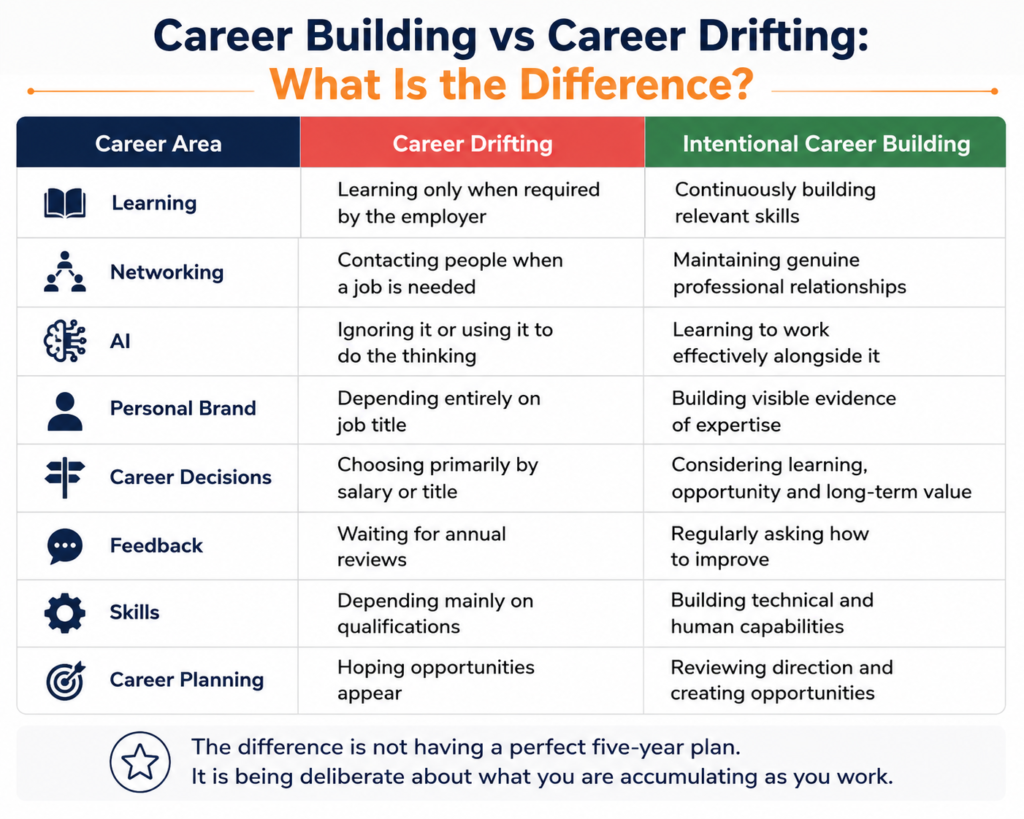
Artificial intelligence, automation and changing business models are transforming jobs faster than traditional career planning models can accommodate. The World Economic Forum’s Future of Jobs Report 2025 estimates that almost 40% of the skills required at work will change by 2030.
The smartest career strategy in your 20s, therefore, is not trying to predict exactly where you will be at 35.
It is becoming valuable, adaptable and visible enough to have choices when you get there.

Mistake 1: Thinking Your Degree Is Your Career Qualification
Graduation feels like the finish line after years of education.
Professionally, it is closer to the starting line.
Employers increasingly evaluate candidates on what they can actually do, not simply what they studied. Practical experience, communication, technological literacy, problem-solving and evidence of initiative increasingly complement formal qualifications.
Your degree may help you enter the room. Your capabilities determine what happens afterwards.
Build practical experience through internships, projects, volunteering, freelance assignments, competitions, certifications and real-world problem solving.
The question to keep asking is:
What can I demonstrate that I know how to do?
That shift from qualification to capability is fundamental to becoming genuinely job-ready.
Mistake 2: Chasing Job Titles Instead of Transferable Skills
A prestigious designation can look impressive on LinkedIn.
But titles do not travel between organisations nearly as well as skills do.
One company’s “manager” may perform work another company assigns to an executive. Instead of evaluating opportunities primarily by designation, examine what the role allows you to learn.
Will you manage projects?
Speak with clients?
Analyse data?
Lead people?
Present ideas?
Use AI?
Solve commercially important problems?
Build systems?
These experiences compound.
A modest title attached to substantial responsibility can accelerate your career more than an impressive title attached to repetitive work.
Mistake 3: Staying Too Long Because You Are Comfortable
Job hopping every few months is rarely a good career strategy.
Neither is staying indefinitely simply because a job feels safe.
Comfort becomes dangerous when learning stops.
There is a difference between stability and stagnation. A stable role can continue challenging you, expanding your responsibilities and developing your expertise. A stagnant role gives you another year of experience without necessarily giving you another year’s worth of growth.
Ask yourself periodically:
Am I learning something today that makes me more valuable than I was twelve months ago?
If the answer consistently becomes no, investigate what needs to change before another three years disappear.
Mistake 4: Ignoring Networking Until You Need a Job
One of the worst times to start building professional relationships is when you desperately need something from them.
Networking should happen while things are going well.
LinkedIn’s 2026 graduate research found that 44% of Gen Z respondents considered not having the right network their biggest barrier to securing entry-level opportunities.
But effective networking is not sending hundreds of strangers messages asking for referrals.
It is building genuine professional familiarity.
Stay connected with former colleagues. Speak to people at industry events. Participate intelligently in professional conversations online. Ask experienced people thoughtful questions. Help others when you can.
A strong professional network is built through accumulated trust, not accumulated connections.
Mistake 5: Keeping Your Best Work Invisible
Doing good work matters.
Making sure the right people understand the value of that work also matters.
Many capable young professionals assume that performance will automatically speak for itself.
Often, it does not.
Document achievements.
Keep records of projects, measurable improvements, testimonials, presentations, campaigns, certifications and problems you helped solve.
Build a professional LinkedIn presence. Create a portfolio where appropriate. Share useful observations about your industry.
This is not about becoming an influencer.
It is about building a professional reputation that exists beyond your current designation.
Your personal brand should gradually answer three questions:
What are you good at?
What do you care about professionally?
Why should someone trust you to do it well?
Mistake 6: Treating AI as Either a Threat or a Shortcut
AI is changing early-career work.
Ignoring it is a mistake.
Using it to avoid learning is another.
Deloitte reported that 85% of Indian Gen Z and millennial respondents were already using generative AI at work in its 2025 research.
That does not mean everyone using AI is becoming more valuable.
Learn how AI improves research, analysis, ideation, productivity, communication and decision-making in your field. At the same time, develop the judgement required to evaluate what AI produces.
The career advantage will increasingly belong to people who can combine technological capability with human judgement, communication, creativity and domain expertise.
Do not outsource your thinking to AI.
Use AI to expand what your thinking can accomplish.

Mistake 7: Neglecting Soft Skills Because You Are Technically Good
Technical competence can get you hired.
Poor communication can prevent you from progressing.
As responsibilities increase, professional success becomes increasingly dependent on your ability to explain ideas, influence decisions, manage disagreement, collaborate and lead.
The World Economic Forum identifies resilience, flexibility, leadership, creative thinking and social influence among skills expected to remain important alongside rapidly growing technological capabilities.
Pay particular attention to:
- Communication
- Listening
- Presentation
- Negotiation
- Emotional intelligence
- Conflict management
- Time management
- Leadership
- Adaptability
These are not “soft” because they are easy.
They are difficult human capabilities that technology cannot simply replace.
Mistake 8: Comparing Your Career Timeline With Everyone Else's
By 27, one friend is managing a team.
Another has launched a business.
Someone else is studying again.
Another is earning twice your salary.
Social media puts all of those milestones on the same screen and makes it easy to conclude that you are behind.
Careers do not compound at identical speeds.
Different industries have different earning curves, promotion cycles and learning paths.
Compare yourself against your own trajectory.
Are your capabilities improving?
Is your responsibility increasing?
Is your professional network stronger?
Are you becoming clearer about the work you want?
Those indicators tell you considerably more about your career than somebody else’s job announcement.
Mistake 9: Optimising Only for Salary
Money matters.
Pretending otherwise is unrealistic.
But especially early in your career, salary should be one factor rather than the only factor.
Consider the quality of your manager, access to meaningful work, learning opportunities, organisational culture, exposure to senior decision-makers and future marketability.
A slightly higher salary in a role that teaches you very little can become expensive later.
Conversely, do not accept chronic underpayment merely because someone promises “exposure.”
The objective is balance: fair compensation today plus increasing professional value tomorrow.
Mistake 10: Waiting for Someone Else to Manage Your Career
Your manager has responsibilities.
Your organisation has objectives.
Neither has primary responsibility for your career.
You do.
Do not wait indefinitely for someone to identify your potential, recommend training, introduce you to mentors or design your next opportunity.
Ask for feedback.
Seek mentors.
Learn independently.
Volunteer for meaningful assignments.
Review your career direction every six to twelve months.
Professional ownership is one of the most valuable habits you can establish in your 20s.
What Should You Prioritise in Your 20s?
If you strip career development down to its essentials, concentrate on five assets.
Skills
Develop capabilities employers and clients genuinely value.
Evidence
Be able to demonstrate what you have accomplished.
Relationships
Build a professional network before you need it.
Reputation
Become known for reliability, curiosity and good work.
Adaptability
Expect your industry, technology and career goals to change.
These assets remain valuable even when individual jobs disappear.

Conclusion: Your 20s Are for Building Career Options
The biggest career mistake you can make in your 20s is believing that every decision has to be permanent.
It does not.
Your first job does not define your career. Neither does your first industry, your first salary, a failed interview or a decision that turns out differently from what you expected.
What matters is whether each experience helps you build something useful: skills, judgement, relationships, resilience, evidence or clarity.
The workplace you enter today will not be the workplace you navigate ten years from now. Technology will change. Roles will disappear and emerge. Your own priorities may change as well.
That is why career success in your 20s should not be measured by how quickly you arrive at a particular title. Measure it by how many meaningful options you are creating for the person you will become.
If you are preparing to move from education into professional life, explore Litos’ Campus-to-Corporate programmes. For support in developing confidence, communication and workplace effectiveness, explore our Personal Development programmes and Coaching & Counseling services. And if your next priority is becoming more visible and credible professionally, our Personal Branding services can help you build a stronger professional presence.
Frequently Asked Questions
Addressing the most common questions about graduate employability challenges and solutions
1. Is it normal not to know what career I want in my 20s?
Yes. Career clarity frequently develops through experience rather than appearing before it. Experiment intelligently, learn what type of work suits you and use each role to gather information about yourself.
2. How often should I change jobs in my 20s?
There is no ideal number. Change when there is a strong reason involving growth, opportunity, environment or career direction rather than following an arbitrary timeline.
3. Should I prioritise salary or experience?
Consider both. Early-career learning can create substantial future earning power, but valuable experience should not become an excuse for employers to chronically underpay you.
3. Is LinkedIn really important for young professionals?
For many professional careers, yes. LinkedIn allows recruiters, employers and professional contacts to understand your experience, skills, interests and professional credibility beyond a conventional resume.
4. What skills should I learn for the future?
AI literacy, technological literacy and data capabilities are increasingly valuable, but analytical thinking, communication, creativity, resilience, leadership and collaboration remain important across industries.
5. Should I use AI to write my resume?
AI can help organise, improve and tailor resume content, but the achievements, experience and claims must remain accurate and genuinely yours.
6. Do I need a personal brand if I am not an entrepreneur?
Yes, although it does not need to mean becoming a content creator. Your professional reputation, expertise, online presence and the way other people describe your capabilities already form a personal brand.
7. When should I seek career guidance?
Career guidance can be particularly useful when you are repeatedly uncertain between options, struggling to identify your strengths, planning a significant career change or finding that your current career direction no longer fits your goals.
Download Build Your Career Capital
Your career grows through what you accumulate—not just the titles you earn. Build valuable skills, evidence, relationships, reputation and adaptability that create better opportunities over time.