
FEATURED ARTICLE
How Freshers in India Can Prepare for Corporate Jobs Before Graduation
April 28, 2026 8 min read By Litos Research Team
The transition from a college campus to a corporate cubicle is often described as a “culture shock.” However, in today’s competitive job market for freshers in India, that shock can be mitigated with early preparation. With the India Skills Report 2026 highlighting that national employability has soared to 56.35%, the message is clear: companies are no longer just looking for degrees; they are hunting for industry-ready talent.
If you are a final-year student wondering how to navigate the campus to corporate transition and turn your syllabus into a paycheck, this guide outlines the roadmap to becoming a top-tier candidate before you even toss your graduation cap.
What Most Freshers Do Wrongly While Preparing for Corporate Jobs
Despite having high ambitions, many Indian graduates fall into common traps that delay their entry into the workforce. In a market where 86% of employers claim talent is available but only 49% are confident in finding it, avoiding these mistakes is what separates the “placed” from the “struggling.”
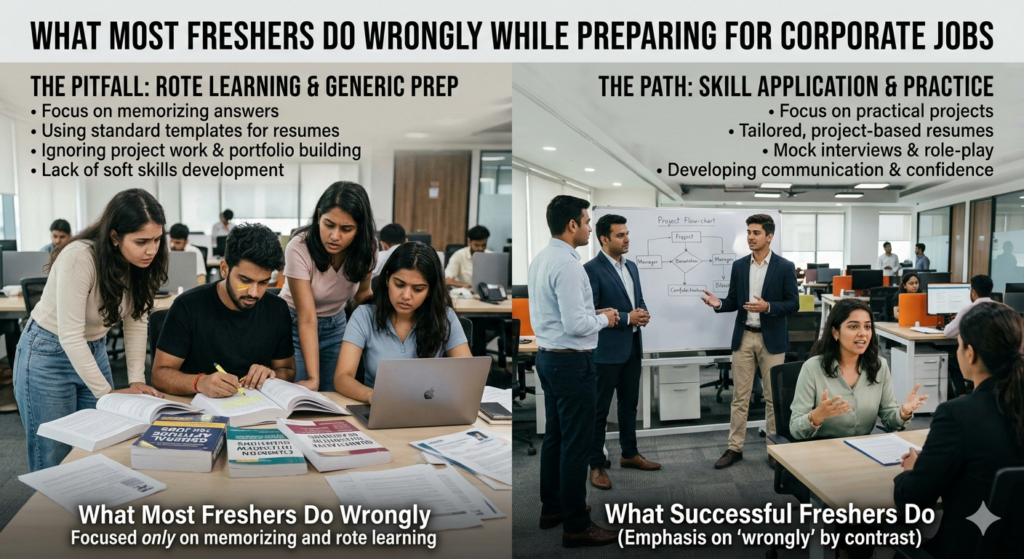
Most freshers focus on marks, not skills—and that’s exactly why they struggle to get hired
1. Prioritizing "Trends" Over "A Strong Foundation."
Many freshers rush to learn advanced topics like Generative AI or Blockchain without mastering core academic fundamentals. Recruiters often report that while a candidate can talk about AI, they struggle with basic DBMS, Operating Systems, or Logical Reasoning.
In 2026, the “readiness gap” often stems from a lack of technical depth; employers would rather hire a fresher who understands the “why” of a core concept than someone who only knows the “how” of a trendy tool.
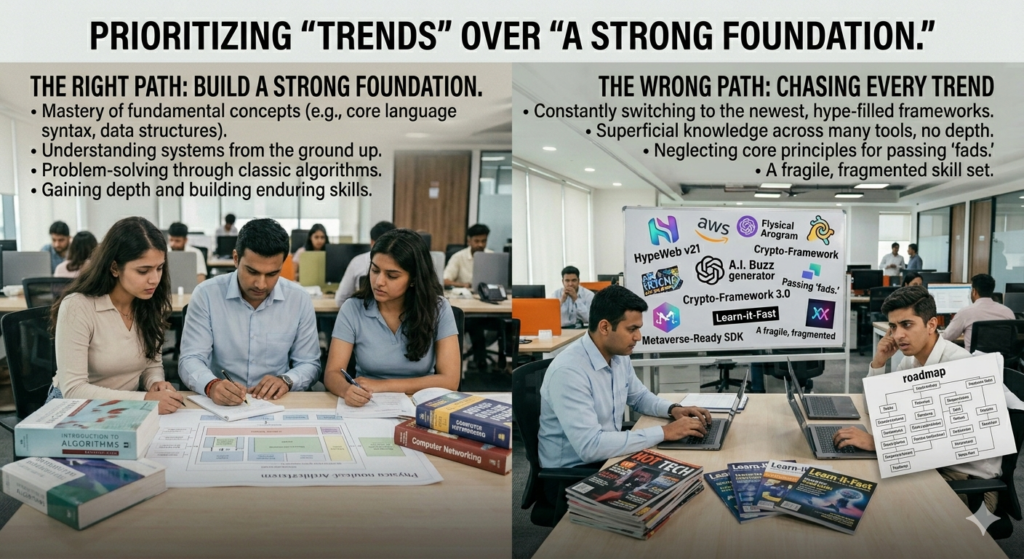
Chasing trends instead of building fundamentals—that’s where most freshers go wrong.
2. Treating the Resume as a "Static History."
Another significant error is using a generic, one-size-fits-all resume for every application. With most HR experts using modern AI-driven Applicant Tracking Systems (ATS), resumes that lack role-specific keywords like “Full-stack development” or “Consumer insights” are filtered out in seconds.
Furthermore, freshers often list “responsibilities” (what they were told to do) rather than “achievements” (the impact they made). A resume that doesn’t quantify results, such as “Increased social media engagement by 15%”,often fails to capture a recruiter’s attention.
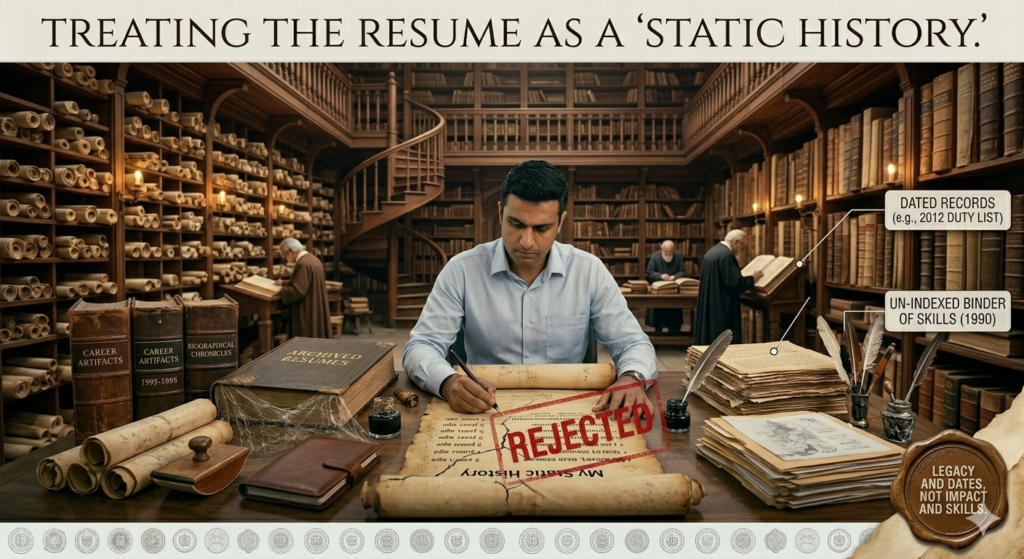
Treating your resume like a static document instead of a living proof of your skills is a big mistake.
3. Miscalculating the Preparation Timeline
Waiting until the final semester to start placement prep is a recipe for failure. Industry experts suggest that corporate readiness requires a 6 to 12-month runway of structured goal setting. Freshers who delay their preparation often miss out on Day Zero companies because they haven’t spent enough time on mock interviews, aptitude practice, or building a “Proof-of-Work” portfolio.
4. Overlooking the "Aptitude Barrier."
Many students focus 100% on their technical skills and 0% on Aptitude Tests. In the Indian corporate landscape, aptitude rounds (Quantitative, Logical, and Verbal) serve as the primary elimination filter. You could be the best coder or marketer in your class, but if you cannot clear the timed aptitude test, the recruiter will never see your technical prowess.
5. Passive Networking and "Ghost" Applications
Simply clicking “Apply” on LinkedIn is no longer enough. Freshers often make the mistake of being invisible until they need a job. Digital Mindfulness in job hunting means engaging with industry leaders, participating in webinars, and seeking mentorship before you need a referral. A silent profile is often interpreted as a lack of initiative, whereas a visible, learning-focused presence builds early authority.
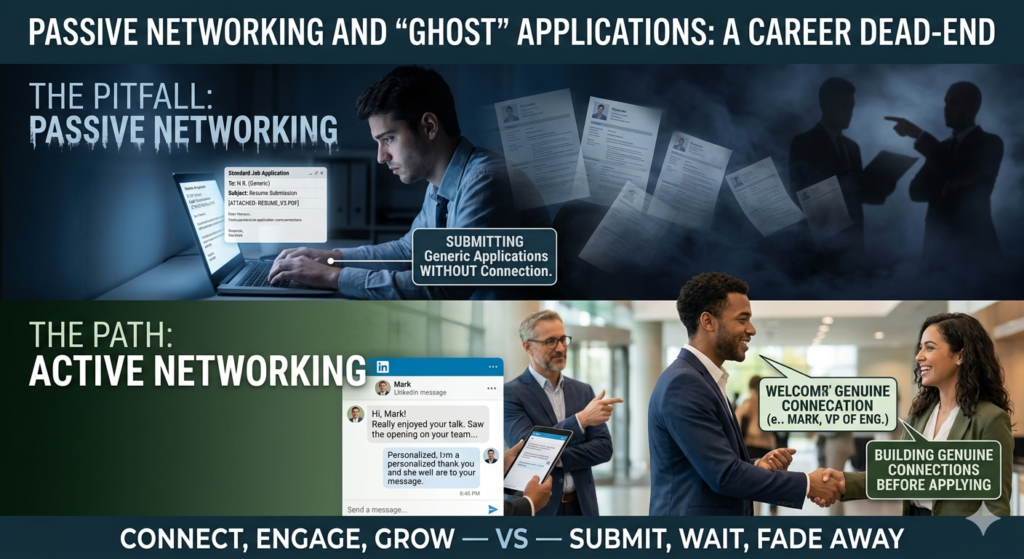
Applying blindly and calling it networking—that’s why most freshers get ignored.
10 Important Steps Students Can Take
- Master "Human+Tech" AI Fluency: Learn to use Generative AI tools (ChatGPT, Claude, or Gemini) to automate redundant tasks while maintaining your unique human voice.
- Optimize Your LinkedIn Profile: Use keywords like "Data-driven decision making" and "Agile methodologies" to rank higher in recruiter searches.
- Build a Proof-of-Work Portfolio: Elevate your personal branding by replacing "hobbies" on your resume with links to GitHub repositories, Behance portfolios, or live project case studies.
- Prioritize 6-Month Internships: Short-term stints are losing value; industry data shows longer internships reduce corporate training time by 40%.
- Acquire Micro-Credentials: Focus on niche certifications in Cybersecurity, Cloud Computing (AWS/Azure), or Digital Marketing to boost starting salary offers.
- Practice Mock Interviews: Use the STAR method (Situation, Task, Action, Result) to answer behavioral questions confidently.
- Develop Data Literacy: Even in non-tech roles, knowing how to interpret a Power BI dashboard or an Excel sheet is a mandatory corporate skill.
- Network Strategically: Connect with alumni from your college already working in your target companies for "inside" advice.
- Refine Business Communication: Master professional email etiquette and virtual meeting presence.
- Engage with Your Placement Cell Early: Follow this dream job guide and don't wait for your final year; attend pre-placement talks starting in your second year to understand market demands.
Key Takeaways
Skills Over Degrees: Practical proficiency in AI fluency, data literacy, and soft skills now outweighs a high GPA.
Digital Presence is Non-Negotiable: Your LinkedIn profile is your secondary resume; keep it professional and active.
Internships are Pre-Placements: Treat every internship as a high-stakes trial for a full-time role; 6-month stints are the new industry gold standard.
Networking is the New Applying: Direct referrals through networking often bypass the "black hole" of automated application systems (ATS).
The Readiness Gap: Freshers by the Numbers
58.35%
National Employability Rate
56.35% (Up from 54.81% in 2025)
54%
Female Employability
54% (Surpassing males for the first time)
40%
Employer Hiring Intent
40% for the FY 2026-27 cycle
84%
Top Hiring Hub
Bengaluru (Leading with 84% hiring intent)

Start early, build real skills, and stay consistent—corporate readiness doesn’t happen in your final semester.
Authority Insight: > “The 2026 hiring landscape has shifted from ‘hiring for potential’ to ‘hiring for immediate contribution.’ India currently holds 16% of the world’s AI talent, and recruiters are prioritizing candidates who can demonstrate AI-supplemented workflows from day one.”
— Litos Research Insights on the 2026 India Skills Report
In This Article
Key Takeaways
- Skills Over Degrees: Practical proficiency in AI fluency, data literacy, and soft skills now outweighs a high GPA.
- Digital Presence is Non-Negotiable: Your LinkedIn profile is your secondary resume; keep it professional and active.
- Internships are Pre-Placements: Treat every internship as a high-stakes trial for a full-time role; 6-month stints are the new industry gold standard.
- Networking is the New Applying: Direct referrals through networking often bypass the "black hole" of automated application systems (ATS).
Campus to Corporate Framework
Download our complete guide with actionable strategies for students and institutions.
Frequently Asked Questions
Addressing the most common questions about graduate employability challenges and solutions
1. What are the highest-paying entry-level jobs in India in 2026?
Currently, roles in AI/ML Engineering, Cybersecurity, and Full-Stack Development offer the highest packages, with some specialists commanding between ₹15 LPA and ₹35 LPA.
2. Can I get a corporate job if I have a low CGPA?
Yes. While a 60% aggregate is a common cutoff for MNCs, 80% of employers now prioritize practical expertise and portfolio strength over marks alone.
3. Which soft skills are most in demand by Indian recruiters right now?
Emotional Intelligence (EQ), critical thinking, and adaptability are the top-rated soft skills. Recruiters want freshers who can navigate hybrid work cultures and solve problems without constant supervision.
4. How early should I start applying for campus placements?
Preparation should start at least 12 months before graduation. This allows time for at least one major internship and the completion of relevant industry certifications.
5. Is the gig economy a good start for a fresher?
Absolutely. Freelancing and gig work now account for 16% of the Indian workforce. It provides a “real-world” portfolio that can eventually be leveraged into a permanent, high-paying corporate role.
Download Our Corporate Readiness Report
Get our comprehensive framework for building effective campus-to-corporate transition pathways.